At the southern tip of Shikoku lies one of the most remote and rewarding corners of Japan. Cape Ashizuri and its surrounding coastline — including the mysterious stone formations of Tojindaba, the otherworldly rock coast of Tatsukushi, and the sacred temple of Kongofukuji — sit at the end of a long drive south through the Kochi mountains. In fact, from Kochi City, the journey takes over two and a half hours by car.
However, that distance is part of the appeal. This is not a place you stumble upon. You come here deliberately, and the reward is a stretch of Pacific coastline that feels genuinely untouched — dramatic, quiet, and full of surprises.
The route described here runs north to south: starting at Tojindaba, moving down to Tatsukushi Coast and its marine facilities, then finishing at Cape Ashizuri and Kongofukuji Temple. It makes for a full and deeply satisfying day.
Contents
- 1 Tojindaba — The Mysterious Megalith Field
- 2 Tatsukushi Coast — A Coastline Like No Other
- 3 Ashizuri Kaiyokan SATOUMI & The Underwater Observatory
- 4 Cape Ashizuri — The Southern Edge of Shikoku
- 5 Kongofukuji Temple — The 38th Temple of the Shikoku Pilgrimage
- 6 How to Get There
- 7 Best Time to Visit
- 8 Where to Stay
- 9 Combining This Area with Other Kochi Highlights
- 10 Tips for Getting the Most from Your Visit
- 11 Frequently Asked Questions
Tojindaba — The Mysterious Megalith Field
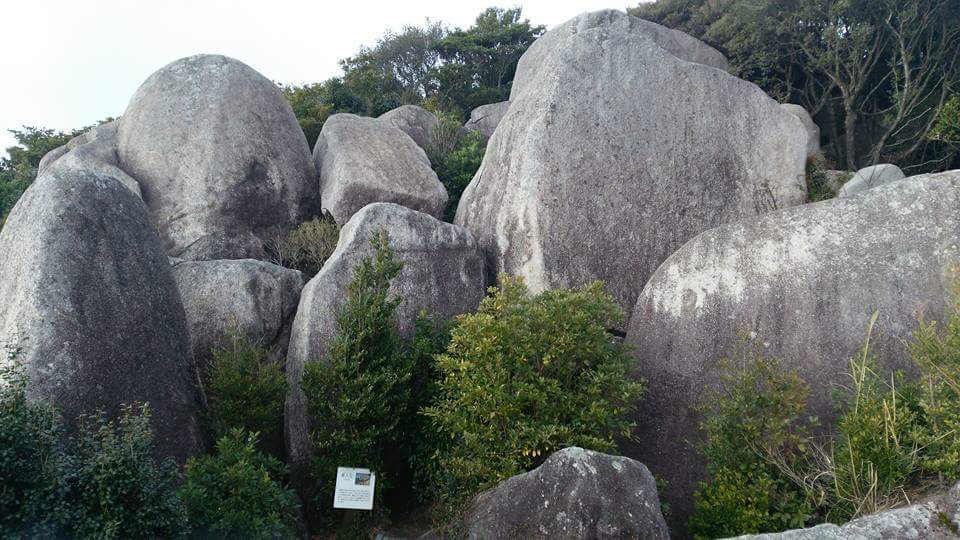
On a hilltop in Tosashimizu City, before you reach the coast, lies a place that raises more questions than it answers. Tojindaba is a field scattered with enormous boulders — some as tall as a person, others arranged in patterns that seem unlikely to be purely natural.
The name itself means “the place where foreigners brought horses,” and local tradition has long associated this site with outsiders from distant lands. Some researchers have drawn connections to Celtic stone cultures or early Portuguese contact with the Tosa coast. None of these theories have been proven. Nevertheless, the ambiguity only deepens the atmosphere of the place.

Walking among the stones, you notice that some appear to have been deliberately placed or shaped. Flat surfaces, aligned edges, and groupings that suggest intentional arrangement — all of it invites speculation. Whether the work of ancient humans or natural geological forces, the result is genuinely eerie and compelling.
What is beyond dispute, however, is the view. From the hilltop, the Pacific Ocean stretches to the horizon in every direction. On a clear day, the curvature of the earth is almost visible. Moreover, visitor numbers here are low — you may well have the entire hilltop to yourself. For a site with this much atmosphere, that solitude is remarkable.

Tatsukushi Coast — A Coastline Like No Other
Continuing south from Tojindaba, the road reaches Tatsukushi Coast — a stretch of shoreline designated as a National Natural Monument and Scenic Site. The reason becomes immediately clear when you step out of the car.
The rocks here have been sculpted by centuries of wind and wave into forms that seem almost surreal. Striated layers of sedimentary rock rise and twist in shapes that resemble animals, abstract sculpture, and alien landscapes. A walking trail follows the coast, passing one extraordinary formation after another.

Glass-Bottom Boat Tour
The waters off Tatsukushi are among the richest coral environments in Japan. The warm Kuroshio Current flows directly past this coastline, supporting coral reefs more typical of subtropical waters. As a result, a glass-bottom boat tour here reveals a world of color and life that surprises most visitors who associate coral reefs with tropical destinations.
Tours depart from the Tatsukushi pier and last approximately 30 minutes. The glass panels in the hull provide clear views of coral, tropical fish, sea urchins, and starfish on the seafloor below.
Minokoushi Coast — The Overlooked Shore
Accessible only by glass-bottom boat or small ferry, Minokoushi Coast is a wild, uninhabited stretch of rock formations just offshore from Tatsukushi. According to local legend, the priest Kobo Daishi passed through this area on his Shikoku pilgrimage but found the terrain too rugged to navigate — and so “left it unseen” (minokoushi). The name has stuck for over a thousand years.
The coastline here is rawer and quieter than the main Tatsukushi area. Furthermore, because it requires a short boat journey to reach, it tends to attract only the most curious visitors. That exclusivity adds to its appeal.
Ashizuri Kaiyokan SATOUMI & The Underwater Observatory
Also in the Tatsukushi area, two facilities offer an even deeper look into the marine world of Cape Ashizuri.
Ashizuri Kaiyokan SATOUMI
🐠 Ashizuri Kaiyokan SATOUMI
Reopened after a major renovation in 2021, SATOUMI is more than a conventional aquarium. Its concept is to recreate the entire marine environment of the Ashizuri-Tatsukushi coastline, from intertidal rock pools to open ocean. The result is one of the most regionally focused and immersive aquariums in Shikoku.
The exhibition zones include “Kuroshio Ocean,” “Coral Sea,” and “Tidal Flat,” each representing a distinct habitat found in the surrounding waters. The large pelagic tank features tuna, yellowtail, and other species carried north by the Kuroshio Current. In addition, a touch pool allows hands-on encounters with local marine life — popular with children and adults alike.
Particularly notable is the coral exhibit. The Tatsukushi marine area supports one of Japan’s most significant coral reef ecosystems, and SATOUMI dedicates substantial space to coral observation and conservation education. It is an eye-opening introduction to a marine environment that most visitors had no idea existed in Kochi.
Hours: 9:00 AM – 5:00 PM (last entry 4:30 PM)
Admission: ¥1,200 adults, ¥600 children
Kaitei-kan — The Underwater Observatory

🔭 Kaitei-kan Underwater Observatory
Just offshore from SATOUMI, connected by a pier that extends over the water, is the Kaitei-kan — an underwater observatory that descends below the surface of Tatsukushi Bay. It offers something the glass-bottom boat cannot: a completely static, unhurried view of the seafloor.
Descending into the cylindrical structure, visitors look out through round portholes at approximately 6 meters below the surface. There is no engine noise, no rocking, no movement. The scene outside the windows changes slowly as fish drift past — sea bream, wrasse, damselfish, and occasionally larger species attracted by the structure itself. Coral formations, sea urchins, and starfish are visible on the seafloor.
Because conditions vary with season and weather, every visit to the Kaitei-kan is slightly different. Furthermore, it remains fully accessible on rainy days when outdoor sightseeing is less appealing. Combined with a glass-bottom boat tour, it gives you a complete picture of the Tatsukushi underwater world — from two very different perspectives.
Hours: 9:00 AM – 5:00 PM
Admission: ¥660 adults, ¥330 children

Cape Ashizuri — The Southern Edge of Shikoku
From Tatsukushi, the road continues south to the tip of the peninsula. Cape Ashizuri is the southernmost point of Shikoku, and the landscape makes that fact feel significant. The cliffs drop over 80 meters to the Pacific below. The white lighthouse at the tip has guided ships through these waters since 1914. And the horizon stretches in every direction without interruption.
Standing at the viewpoint, on a clear day, the curvature of the earth becomes faintly perceptible at the edges of the horizon. It is one of those rare places where the sheer scale of the ocean is genuinely felt rather than merely understood.

John Manjiro (Nakahama Manjiro) Statue
Near the viewpoint stands a bronze statue of John Manjiro (中浜万次郎), one of Kochi Prefecture’s most remarkable historical figures. Born in 1827 in the fishing village of Nakahama — now part of Tosashimizu City — Manjiro went to sea at 14 and was shipwrecked on a deserted island with four other fishermen.
After 143 days surviving on the island, they were rescued by an American whaling vessel. The captain, William Whitfield, took a liking to the young Manjiro and eventually brought him to the United States. Manjiro became the first Japanese person to live in America, attending school in Massachusetts and learning English, navigation, and barrel-making.
He returned to Japan in 1851, during a period when the country was still largely closed to the outside world. As a result, his knowledge of America and the English language made him invaluable to Japanese officials navigating the pressures of the Western powers seeking to open Japan to trade. He served as an interpreter and advisor during the negotiations that led to the opening of Japan, and his life story is considered one of the most extraordinary of the Meiji era.
The statue shows Manjiro gazing out to sea — toward America, toward the unknown, toward possibility. It is a quietly moving sight.

The Camellia Tunnel Path
The walking trail around the cape winds through a dense tunnel of wild camellia trees (yabutsubaki). In January and February, the camellias bloom in deep red, creating a striking canopy of color against the grey winter sky. Even outside the flowering season, the gnarled trunks and thick canopy give the path a timeless, slightly otherworldly atmosphere.
The trail takes approximately 20–30 minutes to walk at a relaxed pace. It connects the main viewpoint with the lighthouse area and Kongofukuji Temple, making it a natural link between the two final stops of the day.
Kongofukuji Temple — The 38th Temple of the Shikoku Pilgrimage
A short walk from the cape viewpoint, Kongofukuji Temple (金剛福寺) is the 38th temple on the Shikoku 88 Temple Pilgrimage — one of Japan’s most famous Buddhist pilgrimage routes. Founded by the monk Kobo Daishi (Kukai) in the 9th century, the temple is dedicated to Senju Kannon (the Thousand-Armed Kannon), the bodhisattva of compassion.
The temple grounds are among the most expansive on the entire Shikoku pilgrimage. A large ornamental pond at the center of the complex reflects the main hall and pagoda. Furthermore, the grounds are home to dozens of turtles — an association with the sea deity traditions of the cape — and the temple is sometimes called “the Temple of Turtles” by locals.

Even for visitors with no connection to the pilgrimage, the temple is worth exploring. The atmosphere of the grounds — pine trees, incense smoke, the sound of bells, white-robed pilgrims completing their circuit — is one of the most evocative in Kochi. Moreover, the combination of cape scenery and temple grounds in a single location makes this one of the most complete experiences in all of Shikoku.
Hours: Open daily
Admission: Free (main grounds)
How to Get There
The Cape Ashizuri area is one of the most remote destinations in Shikoku. Therefore, a rental car is essential. Public transport options are extremely limited and impractical for visiting multiple sites in a single day.
🚃 JR All Shikoku Rail Pass
Traveling across Shikoku by train? The JR All Shikoku Rail Pass gives unlimited travel on the island’s JR network. Use it to reach Kochi City, then rent a car for the drive south to Cape Ashizuri.
Driving Times from Kochi City
From central Kochi City, the drive to Cape Ashizuri takes approximately 2.5–3 hours via National Route 56 and Route 321. The recommended north-to-south route for the day is: Tojindaba → Tatsukushi Coast → SATOUMI & Kaitei-kan → Cape Ashizuri → Kongofukuji Temple.
Allow a full day for this itinerary. An early departure from Kochi (by 7:30–8:00 AM) gives you comfortable time at each location without rushing.
Best Time to Visit
Spring (March–May) is warm and pleasant. The Pacific light is clear, and the drive through the Kochi mountains is scenic with fresh greenery.
Summer (July–August) is the best season for the glass-bottom boat and Kaitei-kan. The coral and tropical fish are at their most active, and the sea is vivid blue. However, typhoon season runs from August through October, so check forecasts before traveling.
Autumn (October–November) offers stable weather, fewer crowds, and excellent visibility from the cape viewpoint. It is arguably the best all-round season for this area.
Winter (January–February) is camellia season at Cape Ashizuri. The walking trail through the camellia tunnel is at its most beautiful. In addition, winter brings the clearest air and the sharpest ocean views.
Where to Stay
Rather than making the long drive back to Kochi City in the evening, consider staying overnight at the Ashizuri Onsen resort area near the cape. Several hotels and ryokan here have ocean-view hot spring baths — a fitting end to a long day of coastal exploration.
🏨 Ashizuri Kokusai Hotel
One of the most established hotels in the Ashizuri Onsen area, offering Pacific-facing rooms and hot spring facilities. Waking up to the sound of the ocean after a full day at the cape is an experience worth the extra night.
🏨 Ashizuri Sunnyside Hotel
A well-regarded option in the Ashizuri Onsen area, combining comfortable accommodation with hot spring access and convenient proximity to Cape Ashizuri and Kongofukuji Temple.
Combining This Area with Other Kochi Highlights
Shimanto River — Japan’s last undammed river, known for its crystal-clear water and railingless submersible bridges, lies to the northeast of Cape Ashizuri. It makes a natural companion for a multi-day western Kochi itinerary. Read our full guide: Shimanto River Guide: Last Clear Stream & Submersible Bridges
Katsurahama Beach — Kochi’s most iconic coastal destination, home to the Sakamoto Ryoma statue and a dramatic Pacific shoreline. It is best combined with Cape Ashizuri as part of a longer Kochi Prefecture trip. Read our full guide: Katsurahama Beach: Ryoma Statue & Pacific Coast Kochi
Tips for Getting the Most from Your Visit
Start early. Leaving Kochi City by 7:30 AM gives you unhurried time at each location. Tojindaba is best in the morning light, and the cape viewpoint at midday — when the sun is high — produces the most vivid ocean color.
If you are visiting in summer, book the glass-bottom boat in advance. Tours can fill up quickly during peak season, and the Tatsukushi marine experience is one of the highlights of the day.
Finally, consider staying overnight at Ashizuri Onsen. The drive back to Kochi City after a full day is long, and the ocean-view hot springs near the cape deserve more than a rushed hour before checkout. Give yourself the morning of the second day to revisit the cape at sunrise — it is one of the finest sunrise spots in all of Shikoku.
Frequently Asked Questions
How far is Cape Ashizuri from Kochi City?
Cape Ashizuri is approximately 90 kilometers from Kochi City by road, taking around 2.5–3 hours to drive via National Route 56 and Route 321. A rental car is essential as public transport options to this area are very limited.
What is Tojindaba?
Tojindaba is a hilltop field scattered with large boulders and mysterious stone formations in Tosashimizu City, Kochi. The name means “the place where foreigners brought horses,” and the site has been associated with various theories about ancient foreign contact. Its exact origins remain unknown, and it offers sweeping views of the Pacific Ocean.
What is the best way to see the coral at Tatsukushi?
There are two excellent options. The glass-bottom boat tour from Tatsukushi pier provides a moving view of coral reefs and tropical fish from above. The Kaitei-kan underwater observatory offers a static, unhurried view through portholes at approximately 6 meters below the surface. Combining both gives you the most complete experience of Tatsukushi’s marine environment.
Who was John Manjiro?
John Manjiro (Nakahama Manjiro, 1827–1898) was a fisherman from Tosashimizu City in Kochi who was shipwrecked as a teenager and rescued by an American whaling ship. He became the first Japanese person to live in the United States, learning English and navigation before returning to Japan. He later served as an interpreter and advisor during Japan’s opening to the West, playing an important role in the events leading to the Meiji Restoration.
Is Kongofukuji Temple open to non-pilgrims?
Yes. Kongofukuji Temple is open to all visitors. While many who come are Shikoku pilgrims (o-henro-san), tourists are welcome to explore the temple grounds freely. The main grounds are free to enter. The temple is open daily.
When is the best time to visit Cape Ashizuri?
Autumn (October–November) offers the most stable weather and excellent visibility. Winter (January–February) is best for the camellia tunnel at its peak bloom, and offers the clearest ocean views. Summer is ideal for marine activities at Tatsukushi. Spring is pleasant and uncrowded. Avoid typhoon season (August–October) if possible.